VERONA FITNESS STUDIO
Verona, Italy
2014 - 2015

A century-old landmark at the origins of Verona's automotive history, transformed into a fitness operation within a nationally protected early-modern building.
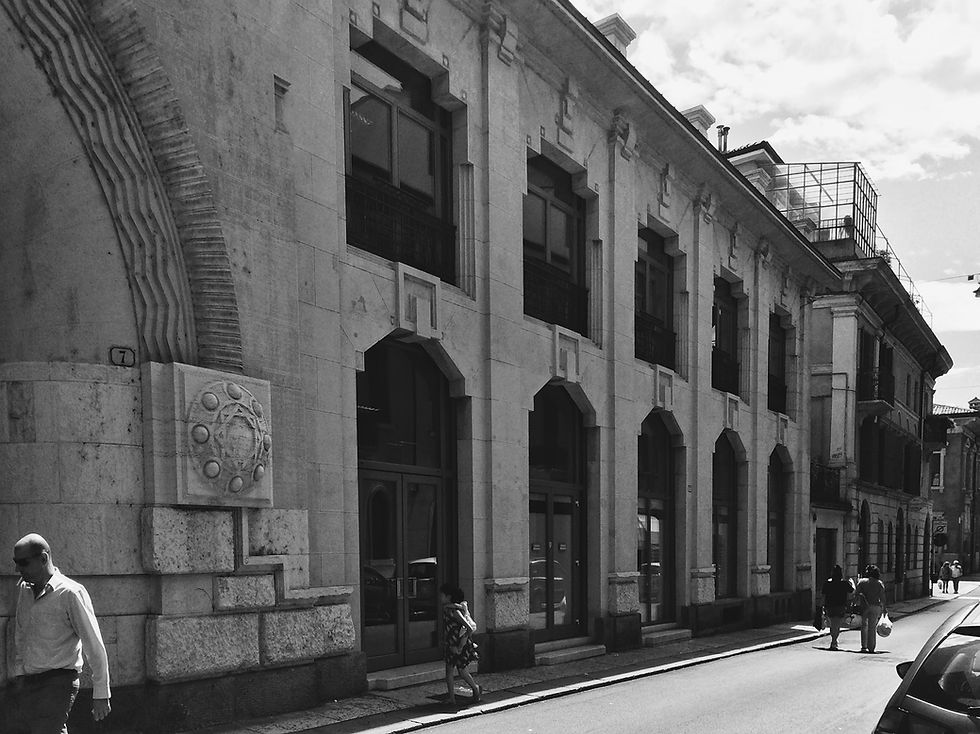
The fitness studio occupies the upper floor of Via Daniele Manin 7, a heritage-listed building in the historic centre of Verona. Designed by Veronese architect Ettore Fagiuoli and constructed between 1911 and 1916, the building served from 1920 as Verona's first authorised FIAT dealership, an early example of a building type that emerged as automobile culture entered Italian urban life. The façade and perimeter walls are marble; the roof system is iron. The building draws on two distinct traditions: the European Iron Architecture building lineage for its structure, and the Vienna Secession for its exterior language. A monumental arched entrance, geometric ornamental detailing, and full-height industrial steel windows gave a functional commercial building the civic presence of a public institution to align the use with the visual standards of the city.


Plinio Codognato, Garage Fiat Verona, post 1919. Collezione Salce, Treviso
After the dealership closed, the building stood vacant for over thirty years. Around 2011, it was fully restored and reopened, with approximately 3,500 square metres of above-ground floor area and its original iron roof structure preserved intact. The ground floor level was converted to retail use. The upper level which is a large-span, daylit open space defined by the original steel trusses and arched windows awaited a new programme.


The project was originally delivered for an Italian fitness operator. Later, the lease was transferred to an international fitness group within an international fitness operator, which rebranded the facility and has operated it continuously since opening in early 2015.

Studio LUMI's involvement began at the site identification stage: locating, within the protected building stock of Verona's historic centre, an asset with the spatial and structural capacity to accommodate a fitness operation, large open floor plates, adequate floor loads, sufficient ceiling height, and viable servicing routes. This required reading two fundamentally different logics at once: the operator's commercial site criteria, and the regulatory and structural constraints of a heritage-protected building.
Through the project delivery process, we acted as the bridge between the asset holder and an international fitness operator. The operator's functional requirements, from electrical system specifications to shower drainage gradients, had to be precisely translated into a buildable scope that respected the heritage framework. Concurrently, approval processes involving the Soprintendenza (heritage authority), the local health authority (ASL), and the fire service (VVF) had to be coordinated in parallel to keep the project on a deliverable timeline.


For projects that convert protected historic buildings to new commercial use, this coordination work is often the factor that determines whether the project is delivered at all. The fitness studio was completed and became operational in 2015. Fagiuoli's iron roof trusses, industrial steel windows, and open spatial layout remain fully legible, now carrying an entirely new fitness programme. The building, a supermarket + a Fitness Studio, has returned to active use as part of Verona's daily urban life.
Project details
TIME
2014 - 2015
TYPE
Fitness \ Urban regeneration \ Commercial space
CLIENT
Private
DESIGN
Fitness Operator
STUDIO CONTRIBUTION
Early-stage / Coordination / Contract / Negotiation / Prosecutor
Discover more

Project
Como Fitness Studio

Project
Happy Fit Vicenza

Project
Hotel Villa Contarini Guizzetti Della Rovere

Project